

59 results found

The Public-Private Infrastructure Advisory Facility (PPIAF) held its Partnership Council Meeting in Vienna, Austria this June. This meeting brought together PPIAF’s esteemed donors and welcomed the Kingdom of Saudi Arabia as the newest donor to PPIAF with their contribution that has supported the integration of the Global Infrastructure Hub (GI Hub) into the PPIAF family. Over the two days, PPIAF engaged in a packed agenda where donors expressed appreciation for the impactful and relevant programs PPIAF delivers.

Non-private institutions, such as multilateral development banks, play a critical role in catalyzing private infrastructure investment in low- and middle-income countries (LMIC). One avenue of support is through the direct co-financing of projects, with over half (55%) of total LMIC investment involving non-private co-financing in 2022. However, the share of LMIC investment financed by the private sector alone has been increasing over time. This has been driven by the renewables sector, reflecting increasing investor confidence in a maturing market as well as relatively smaller project sizes. In general, private sector investors are less likely to require co-financing support from non-private entities in larger LMIC markets, such as Brazil, Russia, India and South Africa.
 Infrastructure Monitor insights


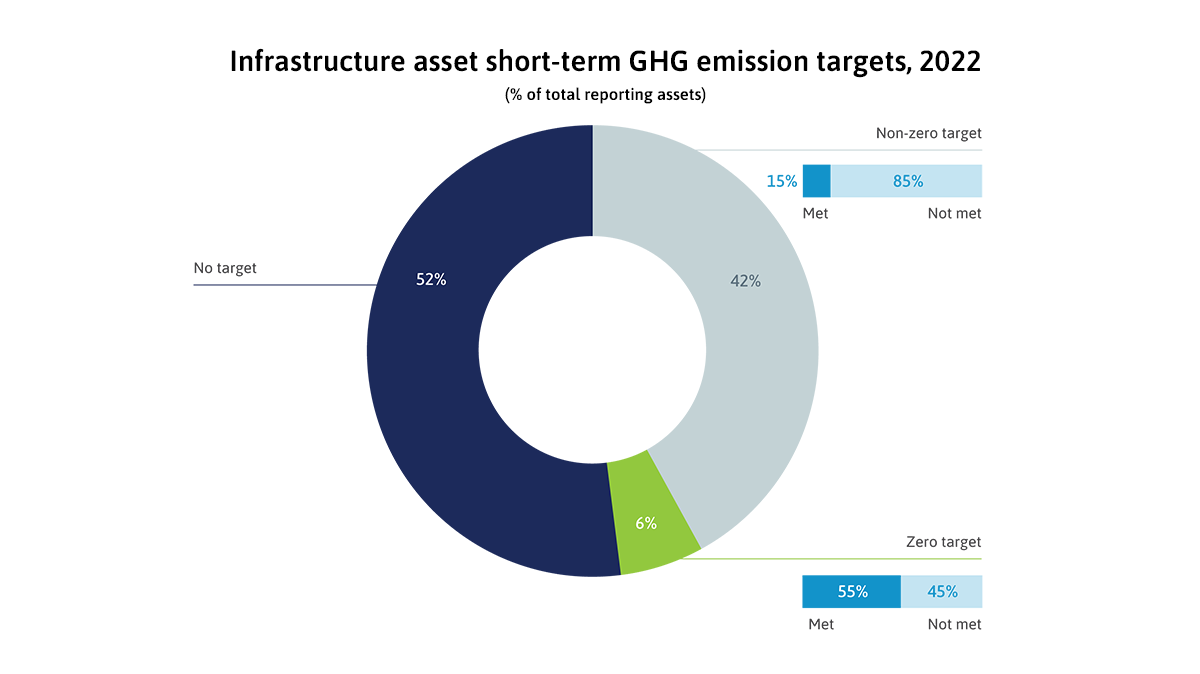
60% of infrastructure assets reporting to GRESB in 2023 currently have a greenhouse gas (GHG) emissions reduction target aligned to net zero. However, these net zero targets may not be ambitious enough. Only a third of assets have a target that is science-based or aligned to a net zero-targeting framework. Further, targets tend to capture only Scope 1 and 2 emissions (omitting Scope 3 emissions) and be location, rather than market-based. However, regional variances exist, with Europe leading the way in Scope 3 and market-based net zero targeting.

In low- and middle-income countries (LMICs), around three-quarters of private investment in infrastructure is conducted in foreign currencies, most commonly USD, and only a quarter in local currencies. Brazil dominates local currency transactions in LMICs and has driven a trend increase in the share of local currency transactions in LMIC investment since 2016.

Regional private investment in infrastructure has seen divergent trends in the post-COVID era, with Western Europe and North America emerging as the two strongest performers, followed by Latin America. Meanwhile Asia, while maintaining relatively stable investment as a share of regional GDP, has experienced the sharpest decline in its share of global private investment in infrastructure, as Western Europe and North America expand their shares. Other regions have seen weaker investment in the post-COVID era (Africa, Oceania, Middle East), or remained stagnant (Eastern Europe).

The number of primary private infrastructure transactions increased by 18% in 2022, the strongest annual growth since 2017, largely driven by strong investor appetite for projects supporting the clean energy transition. However, growth was mostly being driven by high-income countries in North America and Western Europe, with private investment activity in middle- and low-income countries seeing a lot less momentum with volumes on par with pre-COVID levels.
This report of the Independent Expert Group (IEG) of the G20 recommends a triple agenda of reforms to multilateral development banks (MDBs).
 G20 Roadmap for the Implementation of the Recommendations of the G20 Independent Review of Multilateral Development Banks’ Capital Adequacy Frameworks
Independent Review of MDBs' Capital Adequacy Frameworks
Strengthening Multilateral Development Banks: The Triple Agenda Report of the G20 Independent Experts Group
G20 Roadmap for the Implementation of the Recommendations of the G20 Independent Review of Multilateral Development Banks’ Capital Adequacy Frameworks
Independent Review of MDBs' Capital Adequacy Frameworks
Strengthening Multilateral Development Banks: The Triple Agenda Report of the G20 Independent Experts Group

The higher risk profile of greenfield infrastructure, and lack of investment-ready project pipelines, make it challenging to deploy private investment to greenfield infrastructure.

With infrastructure responsible for 79% of global GHGs, JETPs have great potential to rebuild trust among stakeholders and help mobilise private climate finance to support the climate transition and sustainable infrastructure development broadly. The JETP platform offers a valuable sandbox to co-create and validate new approaches and innovations while firming up political will

The credit risk metrics for infrastructure debt improved during the COVID-19 pandemic, while those for non-infrastructure debt worsened. The performance of infrastructure loans demonstrates that infrastructure assets are resilient to adverse economic scenarios like pandemics.
"We have multiple gaps to fund, requiring not billions, but trillions"
Transformative changes are needed to unlock infrastructure financing and fill multiple gaps in financing climate, biodiversity, and infrastructure gtargets.

This article breaks down the blockers to InfraTech adoption and why they occur. Use this article to deepen your understanding of the repercussions of problems like poorly defined value cases and disparate interests among parties across the timeline.
In 2022, infrastructure assets improved their ESG scores in all three pillars of ESG. The scores are encouraging, but they do not mean the assets themselves are more sustainable.

This article reviews five economic shocks that are worsening the bankability of new infrastructure projects, and eight approaches to improve bankability and get projects off the ground.

Infrastructure definitions and classifications (taxonomies) have a huge impact on how much gets invested in infrastructure and what types of infrastructure get this investment. This week the G20 and GI Hub held a roundtable on infrastructure taxonomies to explore how they can be used to help close the infrastructure investment gap.

The Global BIM Network collaborates to co-develop and host an online, open-access knowledge base of resources from governments and organisations championing BIM in public sector construction and infrastructure projects.
This report was produced by an expert panel tasked with independent review of multilateral development banks’ capital adequacy frameworks. This panel was convened by the G20 to provide benchmarks to evaluate MDB capital adequacy frameworks and to enable stakeholders to develop a consistent understanding and consider potential adaptations to maximise MDBs' funding capacity.
The InterAmerican Development Bank´s Sustainable Infrastructure Framework aims to help foster shared understanding of the key dimensions and attributes of sustainable infrastructure. The IDB Framework was adapted to Mexico after a thorough analysis of Mexico’s national development strategy and infrastructure investment priorities, in close collaboration with relevant stakeholders.
 Mexico Projects Hub

Amidst rising interest rates and soaring inflation, infrastructure debt is an increasingly attractive investment strategy for private investors. Alex Murray, Vice President, Research Insights, Preqin explores this trend and what it means for infrastructure investments.

