
Publications
457 results found
This paper provides a contextual commentary on the state of infrastructure delivery around the world. The views within are not necessarily that of the GIobal Infrastructure Hub (GI Hub) but are an important viewpoint to contextualise use of the GI Hub’s Improving Delivery Models initiative framework
 Improving Delivery Models

Infrastructure projects in the Netherlands, such as the construction of roads, bridges and tunnels, have become larger and more complex in recent years. This thesis is about these kinds of infrastructure projects, about the challenges and tensions that go with them, about how people experience them and how they look jointly for solutions, and how they succeed or sometimes fail.
 Download the document [PDF]

A presentation on the current state of the Indonesian economy and economic policy, including in infrastructure sector.
 Link
Link

G20 Leaders endorsed the High Level Principles on Long-Term Investment Financing by Institutional Investors in September 2013, which is intended to help governments facilitate and promote long-term investment by institutional investors.
This paper analyses the outcomes from dynamic pricing of a utility on its profits, in the context of the utility facing competitive fringe, short-run network adjustment costs, theft of service, and the threat of a retaliatory regulatory review.
This policy brief reviews two aspects of independent regulation: institutional efficacy, including primarily autonomy, capacity, and accountability; and the mode of regulation, or the regulator's functional scope. Recommendations are made in the policy brief relating to the entire regulatory process.
Infrastructure projects to carry out environmental impact assessments to prevent adverse impacts on the environment after project implementation.
This study analyses the direct and indirect links between cross-border infrastructural development and poverty reduction under the guise of transport, electricity and communication infrastructure.
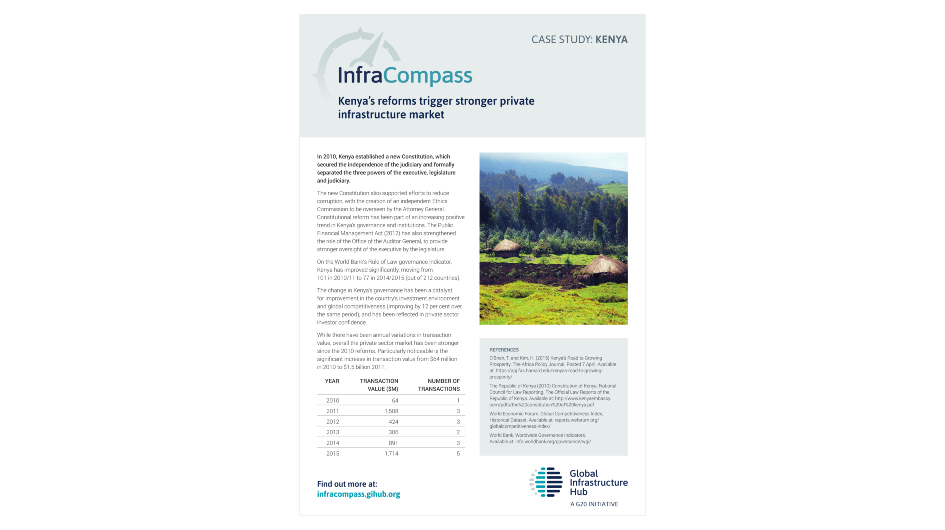
This analysis was drawn from the GI Hub's InfraCompass tool. The case study reflects on how change in Kenya's governance acted as a trigger to make it a stronger private infrastructure marlet.
The Reference tool is meant to serve as a practical tool to help governments and other stakeholders understand and implement the critical success factors that deliver inclusive infrastructure.
InfraTech is defined by the G20’s Infrastructure Working Group (IWG) as “the integration of material, machine, and digital technologies across the infrastructure lifecycle” and is supported by three reference notes produced in collaboration between the G20 IWG, the World Bank and the GI Hub: 1) The InfraTech Stock Take of Use Cases; 2) The Value Drivers for InfraTech; and 3) The InfraTech Policy Toolkit.
The Recommendation calls for governments to assess their public procurement laws and practices at all levels of government in order to promote more effective procurement and reduce the risk of bid rigging in public tenders.
The OECD Recommendation on Public Integrity provides policy makers with a vision for a public integrity strategy.
This publication reports the findings of a 2014 summit on the challenges of urbanization in Latin America and China.


This page discusses the need for legal reform to enhance the PPP environment in EBRD regions.

This Public-Private Partnership (PPP) Handbook is designed for the staff of the Asian Development Bank (ADB) and its developing member countries' clients.

