
Publications
579 results found
Port Development and Competition in East and Southern Africa analyzes the 15 main ports in East and Southern Africa (ESA) to assess whether their proposed capacity enhancements are justified by current and projected demand; whether the current port management approaches sufficiently address not only the maritime capacity needs but also other impediments to port efficiency; and what the expected hierarchy of ports in the region will be in the future.
 Link
Link
 Download


This paper "Pooling of Institutional Investors Capital - Selected Case Studies in unlisted equity infrastructure" aims to provide clarity on some of the issues associated with the evolving field of infrastructure investment and more.
This paper analyses how wider roads or more lanes can reduce vehicle emissions and help people be more mobile and efficient, longer roads can increase emissions, although not in a statistically significant way.
The author evaluates the strength of the effect that community pressure and pollution charges have on industrial pollution control in China, the author finds that the implicit discharge price is at least as high as the explicit price. In other words, community pressure not only exists, but may be as strong an incentive as the pollution charge is for industrial firms to control pollution in China.
The EIB Group is committed to continue maintaining a stringent policy against tax fraud, tax evasion, tax avoidance as well as money laundering and terrorism financing.
This paper provides a condensed yet substantive overview of the key international lessons learned in the area of PBMC.
This paper compares two approaches to the evaluation of mega transport project success: the iron triangle and the holistic approach approach.
Seeking an Efficient Coordination of Investment, Budgeting and Financing Cycles in Latin America and the Caribbean
The Coalition for Climate Resilient Investment (CCRI) created the Physical Climate Risk Assessment Methodology in response to investor demand for comprehensive solutions to improve the integration of physical climate risks into investment appraisal practices.
The country partnership strategy lays out a program of priority activities to support each of three pillars and promotes rebalancing ADB financing toward infrastructure projects in support of the government’s Build, Build, Build infrastructure program.

This paper looks at how to drive needed public sector innovations in infrastructure policy, regulation, finance, procurement and permitting.
The objective of this survey-based study was to understand the main problems encountered by pension funds when investing in infrastructure.
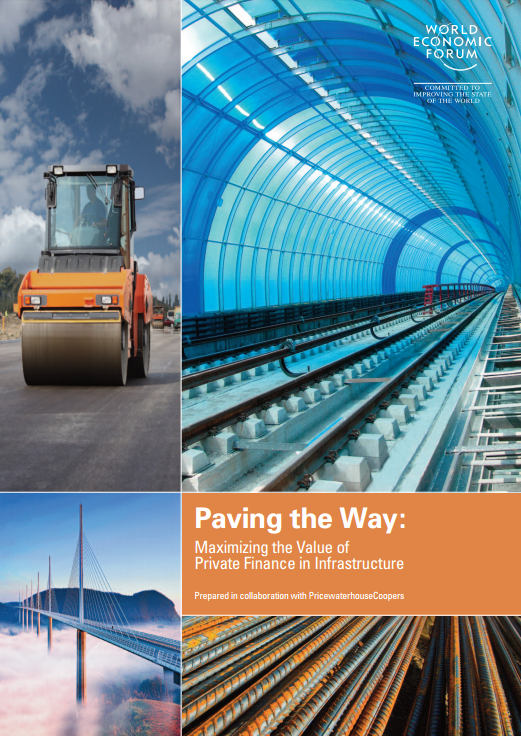
The paper “Partnering to Build a Better World: MDBs’ Common Approaches to Supporting Infrastructure Development” presents a brief description of how MDBs work with their Borrowing Member Countries (BMCs) .
The paper Partnering to Build a Better World: MDBs Common Approaches to Supporting Infrastructure Development presents a brief description of how MDBs work with their Borrowing Member Countries (BMCs) .
This toolkit has been prepared to assist public entities in the state of Maharashtra in India in developing public-private partnership (PPP) urban bus transport projects.
The toolkit provides expert guidance, dependable counsel and a compilation of best practices to assist state legislatures as they consider whether and how to pursue public-private partnerships (PPPs) in their states.

