

938 results found
Featured results

More results

 Download

A presentation on the current state of the Indonesian economy and economic policy, including in infrastructure sector.
 Link
Link


An infrastructure outlook on Indonesia to 2025. A publication by the PwC.

This Fifth edition of the PwC Indonesia Power in Indonesia: Investment and Taxation Guide has been written as a general investment and taxation guide for all stakeholders and those interested in the power sector in Indonesia.

The Independent Power Producers Association of Indonesia ( APLSI ) and PwC Indonesia ( PwC ) spearheaded the preparation of this report, Alternating Currents: Indonesian Power Industry Survey 2018 , based on a survey of stakeholders in the Indonesian power industry.
With regards to the emphasis on the proper risk allocation, the Risk Allocation Guideline, which has been released annually, becomes very essential as a key reference in assessing and allocating risks for the purpose of guarantee provision, as mandated by the regulation.
This is a report of the Asian Development Bank's (ADB) current assessment and strategic investment priorities of the Government of Indonesia and ADB in Indonesia's water supply and sanitation sector.

GI Hub Senior Director for Legal Frameworks and Procurement Policies Mark Moseley gave a presentation at an APEC Business Dialogue aimed at promoting waste management projects being undertaken as Public-Private Partnerships (PPPs) in Indonesia.

Indonesian Ministry of Finance officials visiting Australia met with the GI Hub in Sydney today for discussions on infrastructure.

Although Indonesia’s PPP regulations date back to 2005, initially the number of actual project transactions between the government and private sector was very limited. The private sector’s interest in Indonesian projects was constrained by three main factors; the low quality of project preparation, low financial feasibility of projects (particularly those related to the determination of tariffs) and uncertainty related to the political risk of projects.
 Project Preparation Tool
Introduction: Laying the foundations and charting the way forward
Enabling environment: what are the prerequisites required to facilitate the preparation of quality infrastructure projects?
Financing project preparation: how can governments effectively utilise project preparation financing sources?
What are the benefits of well-planned and prioritised infrastructure investment?
How do you translate a concept into a bankable project?
How should governments communicate projects?
Project Preparation Tool
Introduction: Laying the foundations and charting the way forward
Enabling environment: what are the prerequisites required to facilitate the preparation of quality infrastructure projects?
Financing project preparation: how can governments effectively utilise project preparation financing sources?
What are the benefits of well-planned and prioritised infrastructure investment?
How do you translate a concept into a bankable project?
How should governments communicate projects?

The Indonesian Government aims to expand its geothermal energy sector to reduce greenhouse gas emissions. The Green Climate Fund (GCF) and Clean Technology Fund (CTF) are offering USD127.5m in financing, consisting of a senior concessional loan for public sector projects, a reimbursable grant for private sector projects, and a grant for technical assistance. World Bank will also provide USD100 million loan to scale up investments in geothermal energy in Indonesia.

The rapid growth in Indonesia’s urban areas required a rapid scale up in infrastructure investment. The Government of Indonesia set up Indonesia Infrastructure Guarantee Fund (IIGF) as a state-owned enterprise (SOE) to leverage private investments in infrastructure projects by providing government guarantees or credit enhancements to PPP projects.

The Mass Rapid Transit (MRT) project aims to increase passenger transport capacity of the public transport system, reduce air pollution, and by extension improve Jakarta’s investment climate by delivering a system that accommodates short-distance transport in Central Jakarta.

The toll road section of Jakarta-Bogor-Ciawi in Indonesia is approximately 50 km long and was opened in 1978. It is owned and managed by PT Jasa Marga, a state-owned enterprise responsible for managing many of Indonesia’s toll roads. PT Jasa Marga experienced difficulty accessing private financing for new toll road projects due to the long-term nature of returns, the high delivery risk, the high demand and usage risk, and a historic preference among institutional investors in Indonesia for short-term investments.
As one of Southeast Asia’s largest economic and population hubs, Indonesia is favourably positioned to continue expanding its infrastructure activities.

The first edition of the Public-Private Partnership (PPP) Monitor tracks the development of the PPP business environment as well as the challenges of doing PPPs in nine of the ADB’s developing member countries (DMCs).

This report addresses the critical question: how can the public and private sectors build successful partnerships?
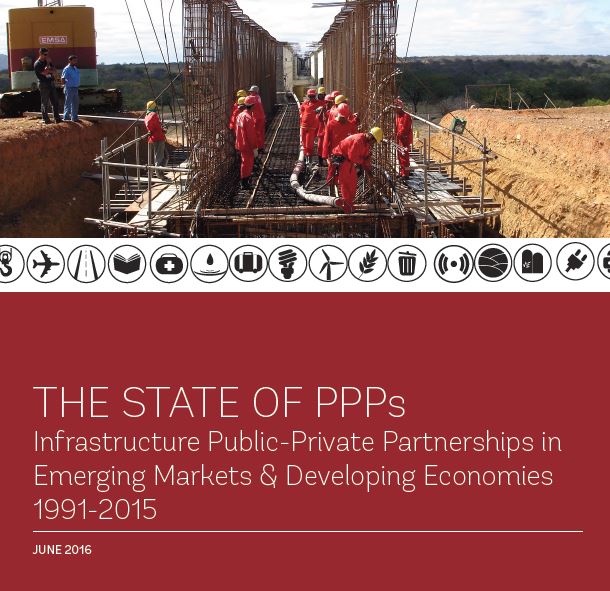
This report uses data from the PPI Database to analyze broad trends of PPP investment in infrastructure from 1991 to 2015.
This PPP checklist is an extension of the initial framework.

