
Articles
Filter by
196 results found

Articles
Good governance is key to excellence in infrastructure development. These five countries are showing the way.
Read time: 3 minutes
Published
01 Oct 2020
View article


Articles
Infrastructure is key to achieving fair and sustainable economic growth and climate targets. Three trends to stimulate the private sector to fund the large-scale change to enable infrastructure to reach its climate and development potential
Read time: 4 minutes
Published
27 Jul 2022
View article

Articles
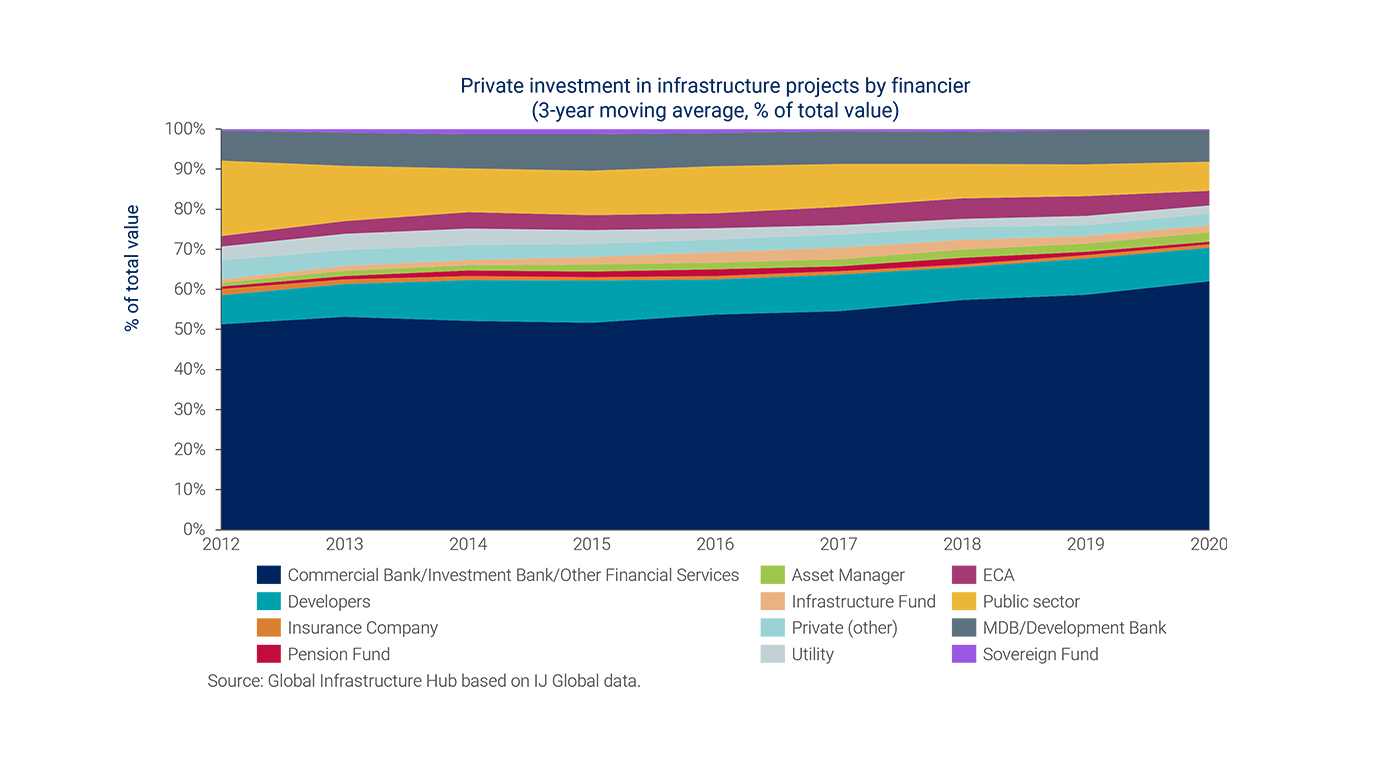
To seize the opportunities of this critical moment and increase private investment in infrastructure LMICs can implement a series of actions. The creation of a regulatory and institutional framework which promotes private investment or the development of solid project pipelines.
Read time: 4 minutes
Published
29 Apr 2022
View article
Articles
The GI Hub began examining the regulatory capital treatment of infrastructure investments in 2019, as part of our initiative to address barriers to the establishment and advancement of infrastructure as an asset class
Read time: 4 minutes
Published
12 May 2022
View article

Articles
Sadek Wahba explores four infrastructure related themes that were re-affirmed at COP26 to deliver on a net zero future
Read time: 5 minutes
Published
25 Nov 2021
View article

Articles
The Infrastructure Knowledge Exchange (IKE) is Global infrastructure Hubs' (GI Hub) database of categorised infrastructure resources. The tool has been created to help Infrastructure professionals globally, to easily find resources that pertain to infrastructure tools, data, publications, organisations, reports and, news.
Read time: 9 minutes
Published
21 Feb 2019
View article

Articles
While infrastructure is a driver of economic prosperity and can provide a solid basis for strong, sustainable, balanced and inclusive growth, it is not a given that infrastructure investment will fully realise these aims without visionary planning and commitment. For infrastructure investment to deliver a more sustainable, resilient and inclusive global recovery, we need to create the right enabling environment now.
Read time: 5 minutes
Published
18 Aug 2020
View article

Articles
The last decade has seen a growing investor appetite toward sustainable infrastructure investments. However, there are challenges to accelerating these investments at the speed and scale needed. In this article we explore two projects - the Tibar Bay Port in Timor-Leste and the Clean Ganga Program in India - that illustrate how these challenges can be overcome.
Read time: 6 minutes
Published
14 Jul 2022
View article

Articles
Interrelated challenges are common bottlenecks in the planning process for linear infrastructure designed to address climate change. This article explores how the Linear Infrastructure Planning Panel is enabling InfraTech for accessible decisionmaking.
Read time: 6 minutes
Published
13 Jun 2023
View article

Articles
What are nature-based solutions, and what role do they play in meeting SDGs and the transition to net zero?
Read time: 5 minutes
Published
27 Nov 2023
View article

Articles
We speak to Sue Barrett, EBRD to find out how the implementation of inclusive infrastructure can be practically achieved at the project level.
Read time: 4 minutes
Published
13 Aug 2020
View article

Articles
The US Senate has passed the $1 trillion Infrastructure Investment and Jobs Act, the ‘historic’ bill promises vital investment in areas from roads, bridges and trains to broadband access and clean drinking water.
Read time: 7 minutes
Published
18 Aug 2021
View article

News
In Buenos Aires on 23 March, the G20 Finance Ministers announced that infrastructure would remain a priority for at least the next three years—a very welcome announcement for those in the private sector who have long called for greater global coordination of efforts in this area.
Read time: 3 minutes
Published
26 Mar 2018
View article

News
The Global Infrastructure Hub’s Outlook shows the United States has one of the largest infrastructure gaps. What can the GI Hub’s InfraCompass tell us about fixing it?
Read time: 3 minutes
Published
07 Sep 2017
View article

Articles
Scaling up existing multilateral solutions and developing new ones are key to increasing much-needed private investment in infrastructure in emerging and developing markets. In her latest article, our CEO, Marie Lam-Frendo shares her thoughts on de-risking instruments as one solution.
Read time: 5 minutes
Published
19 Sep 2023
View article

Articles
Discover the benefits, challenges, risks and trends of ports privatisation.
Read time: 5 minutes
Published
13 Oct 2020
View article

Articles
InfraTech has changed from a nice to have to a critical element in the ability to deliver sustainable, inclusive and resilient infrastructure.
Read time: 5 minutes
Published
03 Aug 2023
View article

Articles
As countries announce major infrastructure packages to stimulate their post-pandemic recovery, the sector faces two substantial and related challenges: climate change and a funding shortfall, writes Marie Lam-Frendo, Chief Executive Officer of the Global Infrastructure Hub.
Read time: 5 minutes
Published
30 Jul 2021
View article

