
Publications
646 results found
This is a self-learning tool for city transport leaders and their advisers, but also a public resource that provides guidance in the planning, design, implementation, and evaluation of an ITS program.
 Visit official website

The Toolkit is a reference guide for public authorities in developing countries for the development of PPP programs in the highways sector, particularly in assisting in PPP policy development, project preparation and the sourcing and more.
This document explains the stages of project development and the level of detail that may be confidently provided to the public at each stage.
 Download
This report compares Johannesburg’s Bus Rapid Transit with Its Latin American Siblings
This paper examines the impact of the STAR highway in the Philippines on public finance.

The study aims to understand the role of specialist investors in UK infrastructure and the impact on performance of vital infrastructure assets over the past decade.
This paper summarizes and expands the state-of-the-art understanding of the urbanization, development, environment, and inequality nexus.

This handbook synthesises and disseminates knowledge to inform the planning, implementation, and operations of urban rail projects.
The 3PA consists of three pillars each of which represents a key dimension of quality project assessment providing a clear framework within which project proposals can be evaluated.
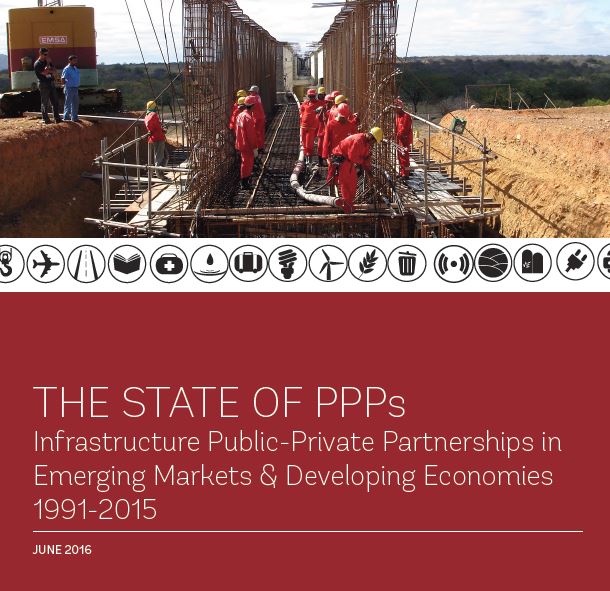
This report uses data from the PPI Database to analyze broad trends of PPP investment in infrastructure from 1991 to 2015.
This report assesses infrastructure PPP investments in an expanded list of Fragile and Conflict Affected States (EFCS2), as well as the PPP regulatory frameworks during the 2012-2016 period.
The ITF Transport Outlook provides an overview of recent trends and near-term prospects for the transport sector at a global level as well as long-term prospects for transport demand to 2050.
This paper examines the evolution of infrastructure and the impact of infrastructure investment and public finance shocks on key development indicators and growth performance in the context of middle income countries.
The report illustrates the ReM framework methodology, used by the EIB in the appraisal and evaluation of projects outside the EU.
This report provides an assessment of the state of regulatory governance in infrastructure industries in Brazil and to suggest possible indicators for future monitoring, while also providing a ranking among Brazillian regulators.
These Guidelines provide a viable framework for prospective bidders (Proponents) to submit innovative and unique ideas (Unsolicited Proposals).
These Guidelines provide a transparent framework for the ACT Government to develop and deliver Public Private Partnership (PPP) projects.
These Guidelines provide a viable framework for prospective bidders (Proponents) to submit innovative and unique ideas (Unsolicited Proposals).
This paper—through a comparative analysis of data from Wuhan and Amsterdam—explores the reasons why the two countries have gone in different directions

