

967 results found
Featured results

More results

Insights into the The Schuphol-Amsterdam-Almere (SAA) program, which has been the largest PPP program in the Netherlands in the last decade.
 Project Preparation Tool
The World Bank Group recently published a primer titled 'Project Development Funds (PDFs) - Supporting Project Preparation to Structure Successful Public-Private Partnerships (PPPs)' to help better understand how to establish and operate PDFs.

The framework provides a description of the job roles, capabilities and learning initiatives for professionals involved in project delivery.
 Link
Link
These documents are used if you’re doing an IPA review. You can also use these documents if you’re doing a non-IPA review, for example, any other government review or a medium risk review.
 Download
Proposing an international action agenda which looks in more detail at what is needed to realize the transition to circular infrastructure on both the EU and international levels

WHO and UNICEF established the Joint Monitoring Programme for Water Supply, Sanitation and Hygiene in 1990, and published regular global updates throughout the Millennium Development Goal period.
The exercise is part of an annual ranking of the PPP context across countries undertaken by the World Bank group.

This document provides guidance for users of NEC in determining the procurement and contract strategies to achieve planned outcomes and in the application of contracts from the NEC3 family in meeting these strategies
Government Procurement Agreement establishes a framework of rights and obligations with respect to laws, regulations, procedures and practices regarding public procurement.

This is a summary of policies and procedures governing procurement and selection of consultants in Bank-financed projects.

The procurement guidelines were introduced in April 2015 by ADB. The purpose of these Guidelines is to inform those carrying out a project that is financed in whole or in part by a loan from the Asian Development Bank (ADB), ADB-financed grant, or ADB-administered funds.

Cities are at the forefront of the pandemic crisis and are key players in the fight to achieve net-zero emissions targets. The recovery choices they make today will set urban agendas for years to come.
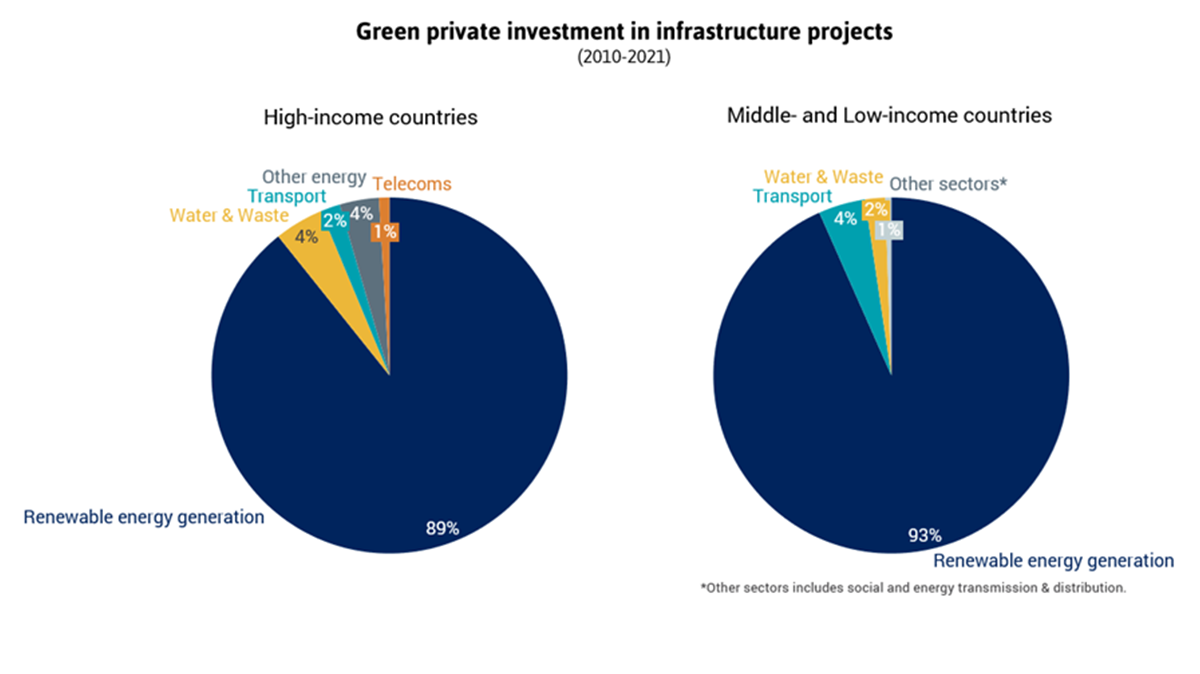
Green investment in infrastructure outside of renewables is limited. While renewables represent almost 90% of total green private investments in infrastructure projects, green investment in other sectors only represent 14%.
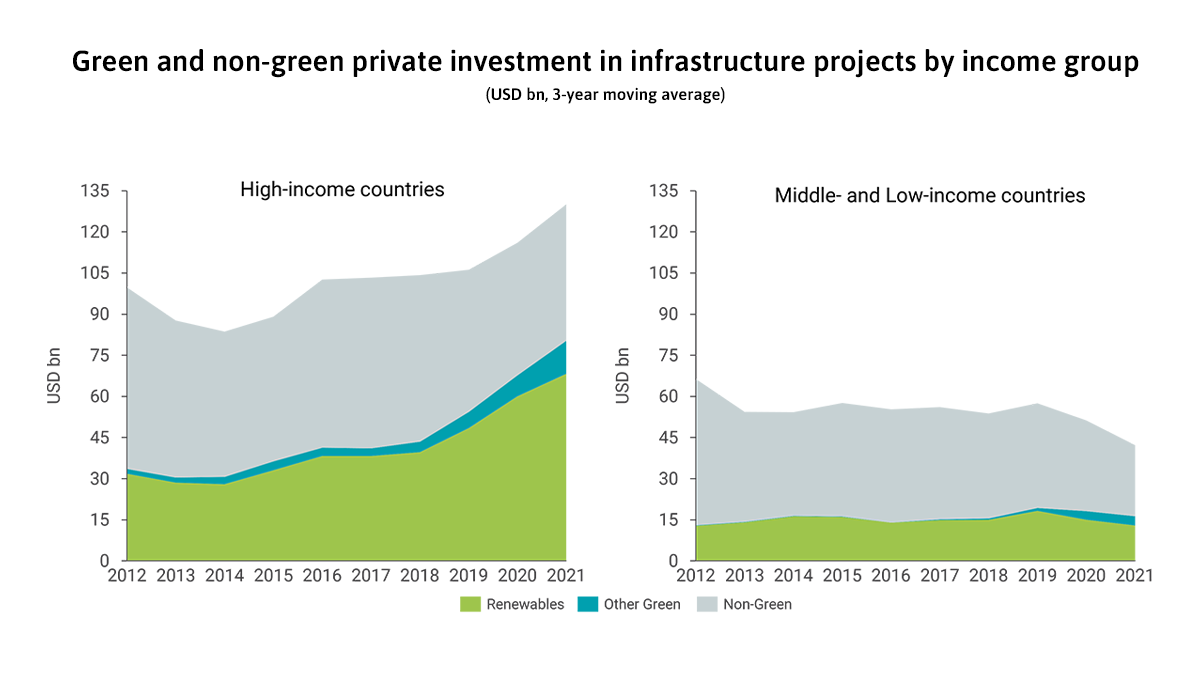
In 2021, global green private investment in infrastructure projects in primary markets rose to a record-high share of 60%, but this trend needs to accelerate and expand beyond renewables to meet climate goals.
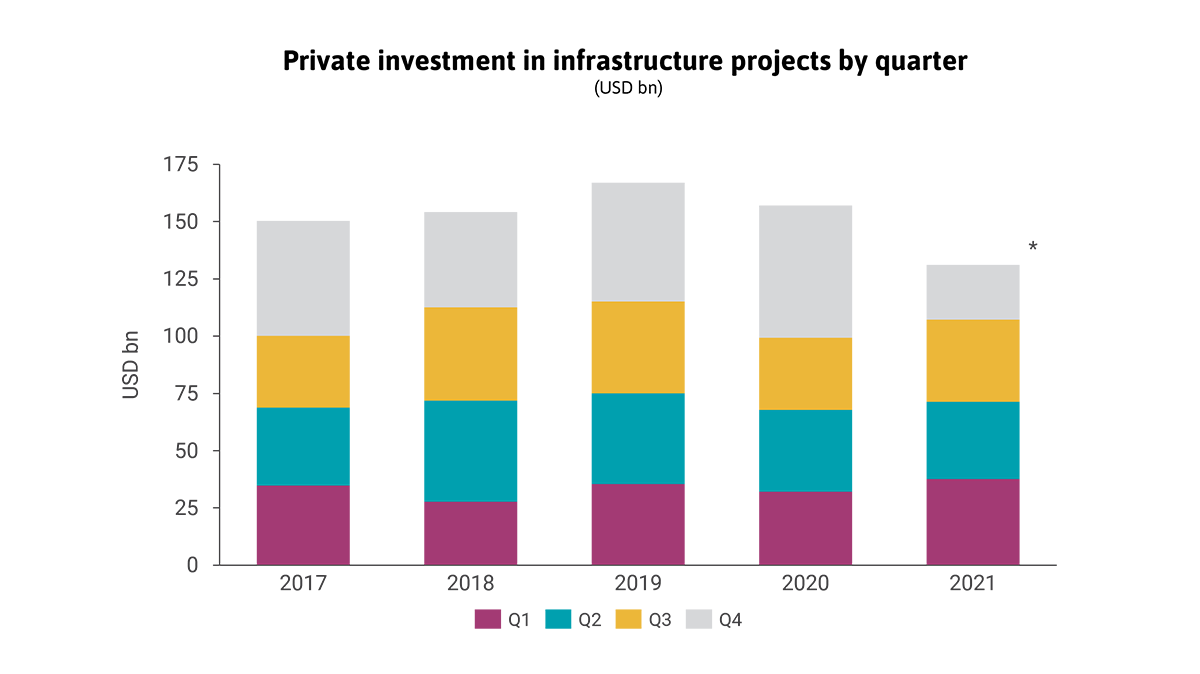
Private investment in infrastructure projects in primary markets was resilient to COVID-19 pandemic shocks

In 2021, private investment in infrastructure projects in primary markets recovered to its pre-pandemic level but remains stagnant and far shy of what is needed to close the infrastructure investment gap.
It addresses the growing worldwide interest in the use of light rail metro transit (LRMT) schemes to provide urban transport solutions and reviews the potential use of public-private partnership (PPP).
This publication draws on the Private Sector Participation (PSP) experience of four emerging economies Brazil, Peru, the Philippines, and Turkey based on in-depth case studies by Energy Sector Management Assistance Program (ESMAP).
This report provides a comprehensive overview of digital transformation in Russia, including chapters on the general digital economy in Russia, the global best practice for enhancing digital platforms in Russa and boosting digital innovation.

