

916 results found
Featured results

More results
This paper uses data from the world bank performance database and the electricity regulatory governance database using electricity company data to the develop the literature that explores the link between regulatory governance and sector performance.
 Download

This paper "Pooling of Institutional Investors Capital - Selected Case Studies in unlisted equity infrastructure" aims to provide clarity on some of the issues associated with the evolving field of infrastructure investment and more.


The Port Reform Toolkit is aimed to provide policymakers and practitioners with effective decision support in undertaking sustainable and well-considered reforms of public institutions that provide, direct, and regulate port services in developing countries.
 Visit official website
The study specifically examines whether power system size and coun¬try per capita income can be reliable indicators of initial conditions for guiding policy on power market structure.
Cost Size: Total Cost of Scheme is INR 1,46,625 Crore and Union Government Support of INR 34,442 cores is to be provided

Building Information Modelling (BIM) and pre-fabrication technology being used in conjunction to enable the project to be built virtually before construction, reducing issues or inefficiencies that can arise during the construction stage.
Deloitte's Analytics Institute published this analysis of how new technology and data analytics can be used for predictive maintenance.

What does resilience to climate change look like and how can we support countries in coping with climate risks?
The OECD Principles for Public Governance of Public-Private Partnerships provide concrete guidance to policy makers on how to make sure that Public-Private Partnerships (PPP) represent value for money for the public sector.
The Infrastructure Prioritization Framework is a multi-criteria decision support tool that considers project outcomes along two dimensions, social-environmental and financial-economic to inform project selection.

This paper examines investments - in the form of equity or debt in direct investments to infrastructure. The reason for focusing on direct investment is twofold. First, the overall analysis of debt and equity capital markets for infrastructure exceeds the scope of this study and involves instruments that trade on regulated stock and bond markets. Second, the analysis of direct investments by private investors in listed infrastructure enables us to focus more on the risk analysis process that these investors typically perform when approaching an investment.

This report gives an overview of the main types of government and market based instruments and incentives able to boost the mobilisation of financial resources to long-term investment.
This report provides a comprehensive overview of digital transformation in Russia, including chapters on the general digital economy in Russia, the global best practice for enhancing digital platforms in Russa and boosting digital innovation.
This publication draws on the Private Sector Participation (PSP) experience of four emerging economies Brazil, Peru, the Philippines, and Turkey based on in-depth case studies by Energy Sector Management Assistance Program (ESMAP).
It addresses the growing worldwide interest in the use of light rail metro transit (LRMT) schemes to provide urban transport solutions and reviews the potential use of public-private partnership (PPP).

In 2021, private investment in infrastructure projects in primary markets recovered to its pre-pandemic level but remains stagnant and far shy of what is needed to close the infrastructure investment gap.
 Infrastructure Monitor
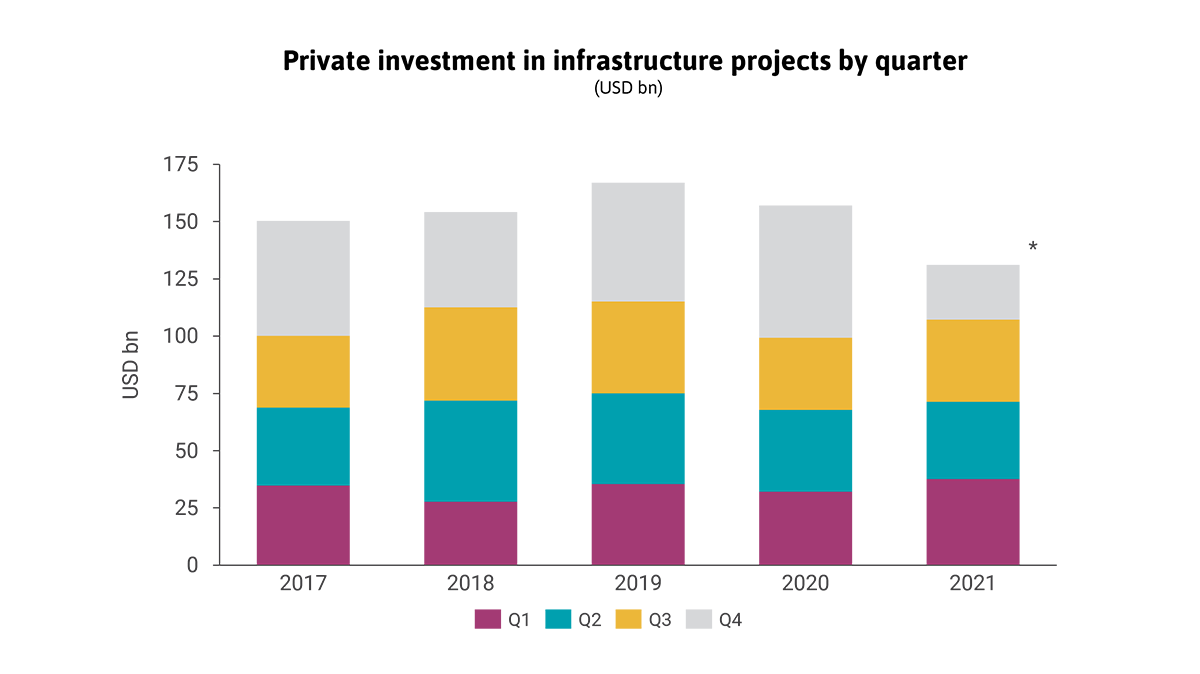
Private investment in infrastructure projects in primary markets was resilient to COVID-19 pandemic shocks
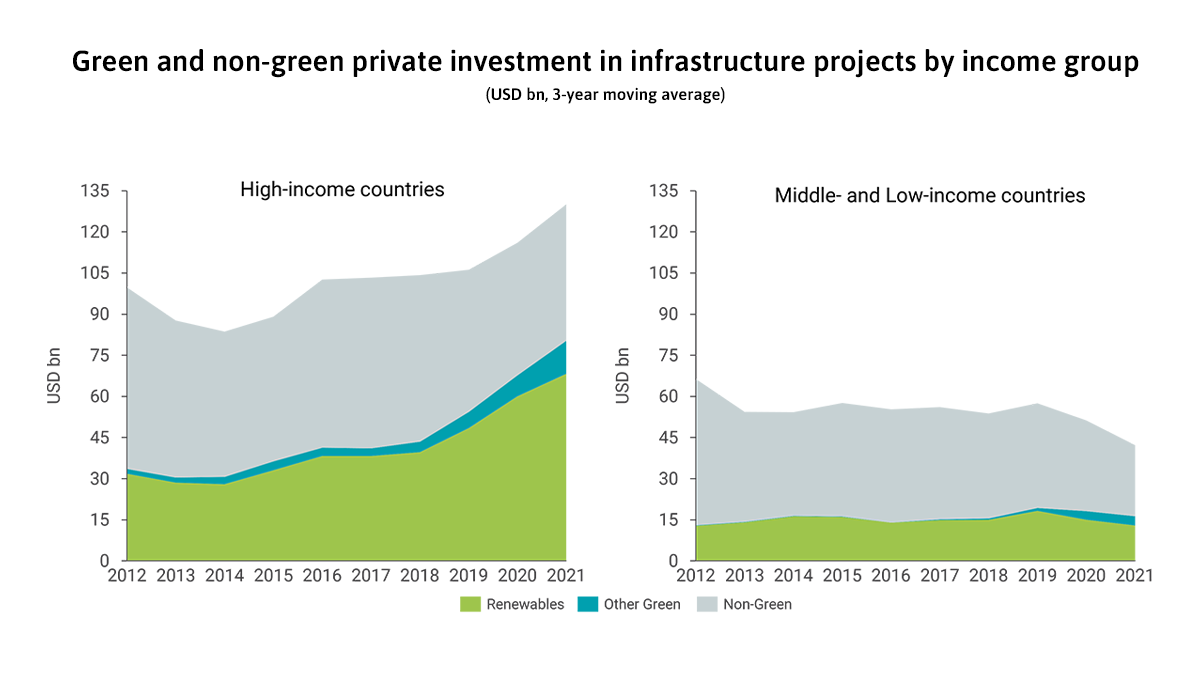
In 2021, global green private investment in infrastructure projects in primary markets rose to a record-high share of 60%, but this trend needs to accelerate and expand beyond renewables to meet climate goals.
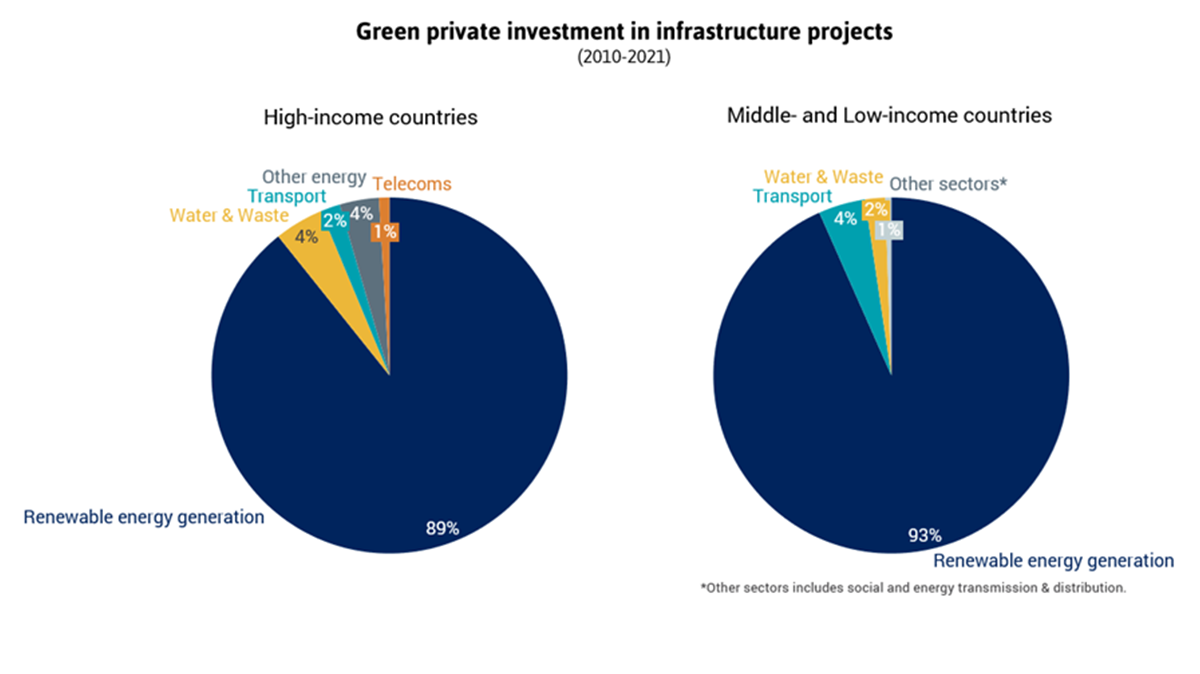
Green investment in infrastructure outside of renewables is limited. While renewables represent almost 90% of total green private investments in infrastructure projects, green investment in other sectors only represent 14%.

